⚡ Launch offer — Palimpsest at €29 instead of €49 · ends in … · October 5, 00:00 (UTC+2)
⚡ Launch price — €29 until October 5th (then €49) One license · all formats · lifetime updates

Palimpsest
The Synth That Learns Your Harmony

A synth whose memory is its timbre. What you play carves the instrument — lean on fifths for an evening and sympathetic strings tuned a fifth away answer every note you play. What you stop playing fades.

It never records your notes and never plays them back. It remembers the interval, not the note — in one memory per machine, shared by every instance, that outlives the session.

Buy Palimpsest — €29€49 ↓ Download Demo
1 Memory per Machine
84 Presets
11 Measured Bodies
3 Stereo Outputs

See It in Action

The Same Notes, A Different Memory

Seven short pieces. In each one, A is the MIDI played on a fresh Palimpsest — an ideal, untouched string — and the other buttons are the exact same MIDI played on a memory somebody else carved for eight minutes. Nothing else changes: not the preset, not a knob. Only what the instrument remembers.

Slow bloom pads · 72 bpm · 1 instance held chords — listen for the strings that keep ringing under them
Under dust keys · 84 bpm · 1 instance the memory colours the attack, then answers in the tail
Small stones plucked · 96 bpm · 1 instance short notes — what rings after each one is the memory
Shared memory bass, pad, keys, lead · 76 bpm · 4 instances four tracks, one memory — every instance reads the same carving
Foundry floor kick, toms, metal · 108 bpm · 3 instances percussion carves too — the intervals between the drums
Two rooms away drone, chords, bell · 58 bpm · 3 instances slow music — the sympathetic strings have time to answer
Nightbus bass, pad, stabs · 118 bpm · 3 instances fast music — the memory sits in the timbre more than in the tail

Rendered in a real DAW with the shipping plugin, from the same MIDI files · loudness-matched (−18 LUFS) so the louder one never wins by default. Music: xeniclex.

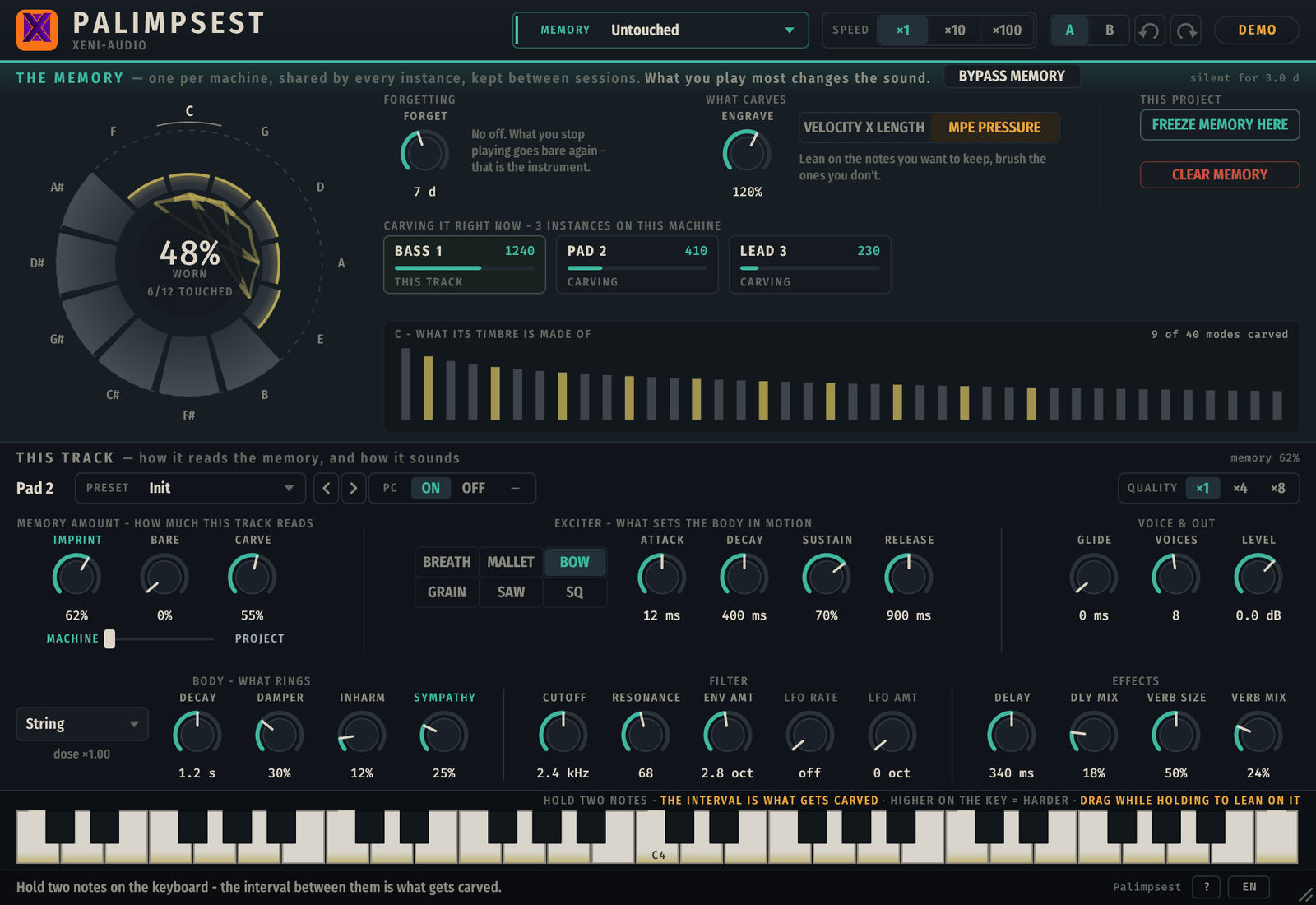
Palimpsest interface — the memory band with the twelve-segment wear map, the two laws Forgetting and Engrave, the shipped-memory selector, and below it this track's preset, body, exciter, ladder filter and outputs

The top band is the memory — the map shows what has been carved, warm when fresh, verdigris as it ages. Below it, this track: the body that rings, what sets it in motion, the filter, the outputs.

The Memory Is the Timbre

Every synth sounds the same on the day you buy it and on the day you sell it. Palimpsest doesn't: after a month it sounds like the way you play — and nobody else's does.

✍️
The Interval, Not the Note
It takes two notes to write — together, or one after another. The interval between them is what gets carved, so a fifth in C and a fifth in F# wear the same groove. The intervals you lean on grow into the timbre as overtones.
🎻
Sympathetic Strings
Strings tuned to the intervals your memory holds start ringing under your melody and keep ringing after the note. Lean on fifths and every note you play gets answered a fifth away. A fresh Palimpsest has none: they are earned.
🌫️
Forgetting Is Structural
There is no off switch. What you stop playing goes bare again, in days of wall-clock time — it forgets even while your DAW is closed. Play something else and the old answers fade while the new ones arrive.
🧠
One Memory per Machine
Not per track, not per project. Every instance in every session reads and carves the same memory through shared memory, and it survives the session: close your DAW tonight, open it next week, it still remembers you.

Watch the Memory Carve

A player leans on fifths, then on thirds, then stops. Each interval inks its segment on the map, a sympathetic string tuned to it starts answering, and everything that is no longer played fades.

● THE MEMORY — twelve intervals, one map what is played is written · what is not is forgotten FRESH MEMORY
✍️ Two notes write one interval — never a note 🎻 A carved interval becomes a string that answers 🌫️ Fresh ink is warm, old ink is verdigris, silence erases

In the plugin, that's the map in the top band — twelve segments, one per pitch class, and a detail strip showing the forty modes actually sounding.

Two Laws, and Memories You Can Load

Engrave sets how strongly playing writes; Forgetting sets how long silence takes to erase. Load a memory somebody else carved — Gospel keys, Modal techno, Flamenco, Gamelan — play on top of it, and it becomes yours. Freeze one into a project when a track must stay the way it was recorded. And a Speed switch — ×1, ×10, ×100 — makes the whole machine remember and forget faster, to hear in a minute what would take a week.
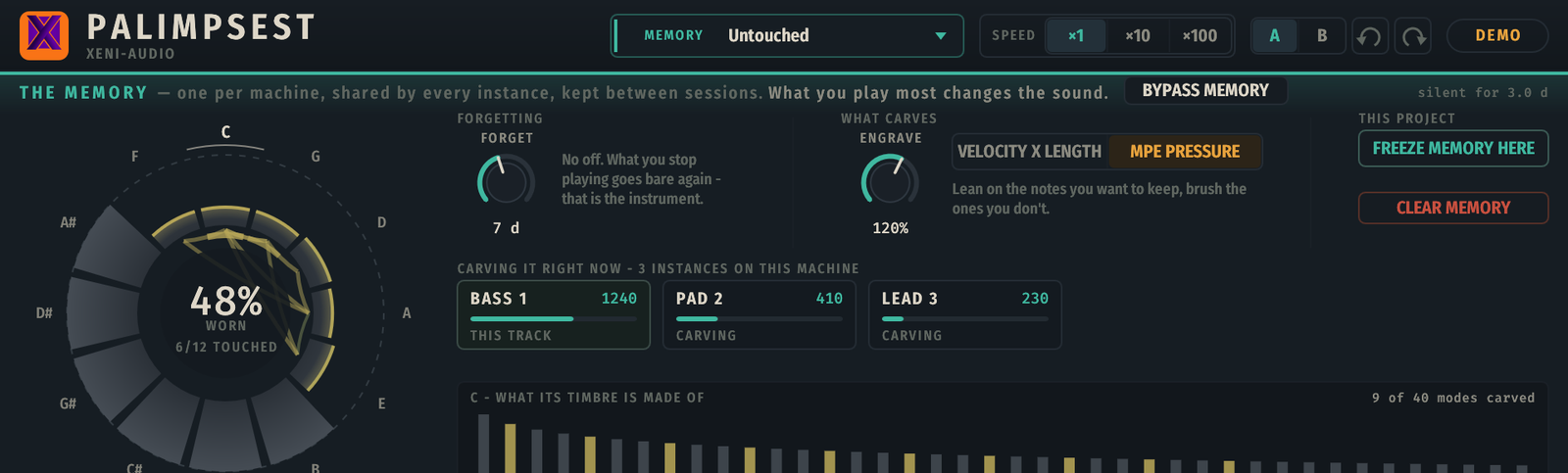
The Palimpsest memory band — the twelve-segment map, the Forgetting and Engrave laws, the Velocity × length / MPE pressure switch, Freeze memory here, Clear memory, the Speed switch and the instance park

The instance park at the right names every Palimpsest running on this machine and what each one is carving — all into the same memory.

Everything You Need

🔔
Eleven Bodies, Six Exciters
A modal synth: a measured physical body — from a struck key to a bowed string to a cracked bell — set in motion by a pluck, a strike, a bow, noise, a saw or a square. Then a ladder filter and effects.
🎹
84 Presets That Tell Stories
Keys, pads, bass, leads, textures, machines, percussion. Every preset sounds different on every memory — the preset is the instrument, the memory is who has been playing it.
📚
Shipped Memories & Yours
Memories someone already carved for eight minutes — Gospel keys, Modal techno, Whole-tone, Flamenco, Gamelan, Delta blues, Pastorale. Save yours, name them, come back to them. Loading one backs up the current one first.
🎚️
Imprint, Sympathy, Carve
Per track: how much the memory colours the timbre, how loud the sympathetic strings answer, and how much this track carves. A track can read the memory without writing it — or write without reading.
🔀
Three Stereo Outputs
Main is the instrument. Bare is the same notes on a fresh, untouched Palimpsest. Wear is exactly what your memory adds. Keep the melody on one track and its wear on another, with its own effects.
🖐️
MPE: Pressure Engraves
With an MPE controller, pressure is what writes — press hard on what you want to keep, brush what you don't. On an ordinary keyboard, velocity and held length do the same.
❄️
Freeze Memory Here
Keeps a copy of the current memory inside the project file. The live memory keeps evolving; the frozen one does not. A Machine ↔ Project fader blends between the two.
📖
Guided Tour & Six Languages
A tour at first launch that sits next to each control, a hint bar that explains whatever you hover — in English, French, German, Spanish, Italian and Portuguese — and a full PDF manual in every download.

Not a Looper, Not a MIDI Capture

Palimpsest never records your notes and never plays them back: your melody is exactly what you played, always. It is not a delay either — nothing is repeated. Playing wears the sound itself, slowly, the way footsteps wear a stone step. The demo carves the very same memory the full version inherits.

Technical Details

Type Instrument — MIDI in, three stereo outputs (Main, Bare, Wear)
Formats VST3 · Audio Unit (macOS) · CLAP
Platforms Windows 10/11 x64 · Linux x86-64 · macOS 10.13+ (universal, Intel & Apple Silicon)
Synthesis Modal — 11 measured bodies, 6 exciters, 40 modes per voice, ladder filter, effects
Memory One per machine, shared by every instance through lock-free shared memory; persisted on disk as user data, it survives sessions and reboots
What carves Velocity × held length on any keyboard; pressure with an MPE controller
Presets 84 factory presets in seven families, user presets, Program Change
Memories Shipped memories, your own named memories, automatic backups, freeze into the project
Parameters Automatable in VST3, AU and CLAP hosts · A/B · undo
Languages Interface in English; hints, tour and info bar in EN · FR · DE · ES · IT · PT
Framework Built with iPlug2 — open-source C++ audio plugin framework
License Perpetual, all your machines, free updates. Separate key from the other XeniAudio plugins.

Try Before You Buy

The demo is the whole instrument — every preset, every shipped memory, your settings saved with the session. The only limit is that the audio goes silent for five seconds every minute. It keeps carving during the silence, and the memory you build in the demo is the one the full version inherits. Play it for real, over days, not over a test clip. No sign-up required.

🪟
Windows
VST3 · CLAP — Windows 10/11 x64
↓ Installer (.exe) ↓ Archive (.zip)
🐧
Linux
VST3 · CLAP — x86-64
↓ Archive (.tar.gz)
🍎
macOS
VST3, AU & CLAP — macOS 10.13+ Intel & Apple Silicon
↓ Installer (.dmg)
🪟 Windows users — SmartScreen or antivirus warning? Click here

The Windows installer isn't code-signed, so SmartScreen may flag an unknown publisher. It's not a detection — keep the file and open it.

  1. Click "More info", then "Run anyway"
  2. Or skip the installer entirely: the .zip above contains the same VST3 and CLAP files — copy them into C:\Program Files\Common Files\VST3\ and C:\Program Files\Common Files\CLAP\

macOS

Nothing to do. The disk image, the installer and all three plugin bundles are signed with an Apple Developer ID and notarized by Apple, with the ticket stapled into the files so it works offline. The publisher shows as Tony Cuny — the legal name behind Xeni-Audio, which is what Apple puts on the certificate. Logic loads the AU with no workaround.

Free demo, no sign-up required. Insert it on an instrument track and send it MIDI — a keyboard, or a clip. It makes no sound on its own, and three of its knobs do nothing until something has been carved: a fresh instrument arrives already played for twenty seconds so you hear them from the first note. After download, refer to the included README.txt and the PDF manual for installation — the manual is also readable online. The same demo is also available on Gumroad. Questions? support@xeni-audio.com

Changelog

Latest: v1.0.0all versions

1.0.025 Sep 2026

  • First release.
€29 €49€49

Launch price until October 5th — then €49. One license, all formats, all platforms, all your machines, forever.

  • VST3, Audio Unit & CLAP formats
  • Windows · Linux · macOS (universal)
  • One memory per machine — every instance carves and reads it
  • 11 measured bodies, 6 exciters, ladder filter, effects
  • 84 presets in seven families, shipped memories and yours
  • Sympathetic strings tuned to what you play
  • Three stereo outputs — Main, Bare, Wear
  • MPE: pressure engraves
  • Guided tour and hints in six languages
  • All future updates
  • Separate license key from other XeniAudio plugins
Buy on Gumroad — €29€49
Secure checkout via Gumroad · License delivered by email