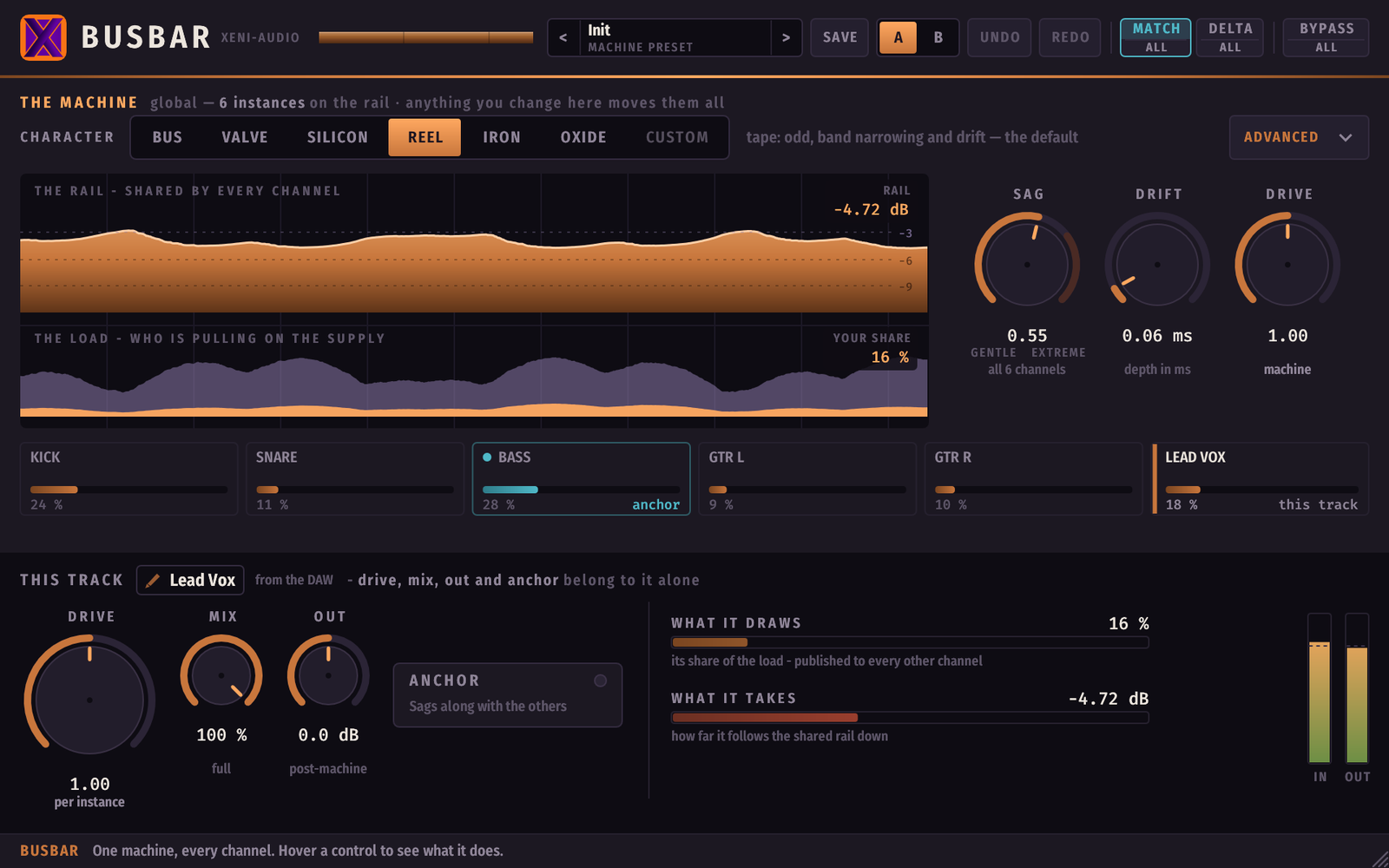
The copper bar is the rail, and it gets thinner under load — below it, the stacked meter shows who is pulling, and the park shows every channel on the machine. The bass is anchored.
Analog saturation, but shared. Every track runs through one machine — push the kick and the whole mix leans with it, the way a console glues a mix.
Six deaf boxes become six channels of one desk. Each track feels how hard the others push, no routing.
One Busbar on every track of “Dark Good Time”, all sharing a single machine. Flip between the characters — the whole mix leans together, the way a console does.
Music: xeniclex · loudness-matched A/B, rendered in a real DAW.
The copper bar is the rail, and it gets thinner under load — below it, the stacked meter shows who is pulling, and the park shows every channel on the machine. The bass is anchored.
The mix moves as one body, not six unrelated ones — and one track can be the one that never gives way.
One supply for every channel. Push any track and the shared rail thins, so every ceiling comes down at once. Anchor a track and it loads the rail but never gives way.
In the plugin, that's the copper bar across the top of the window — thinner the harder the mix pushes.
One lane per track. Click another to take its controls without leaving your window — a violet band shows where you are, and the change reaches the other instance even with its window closed.
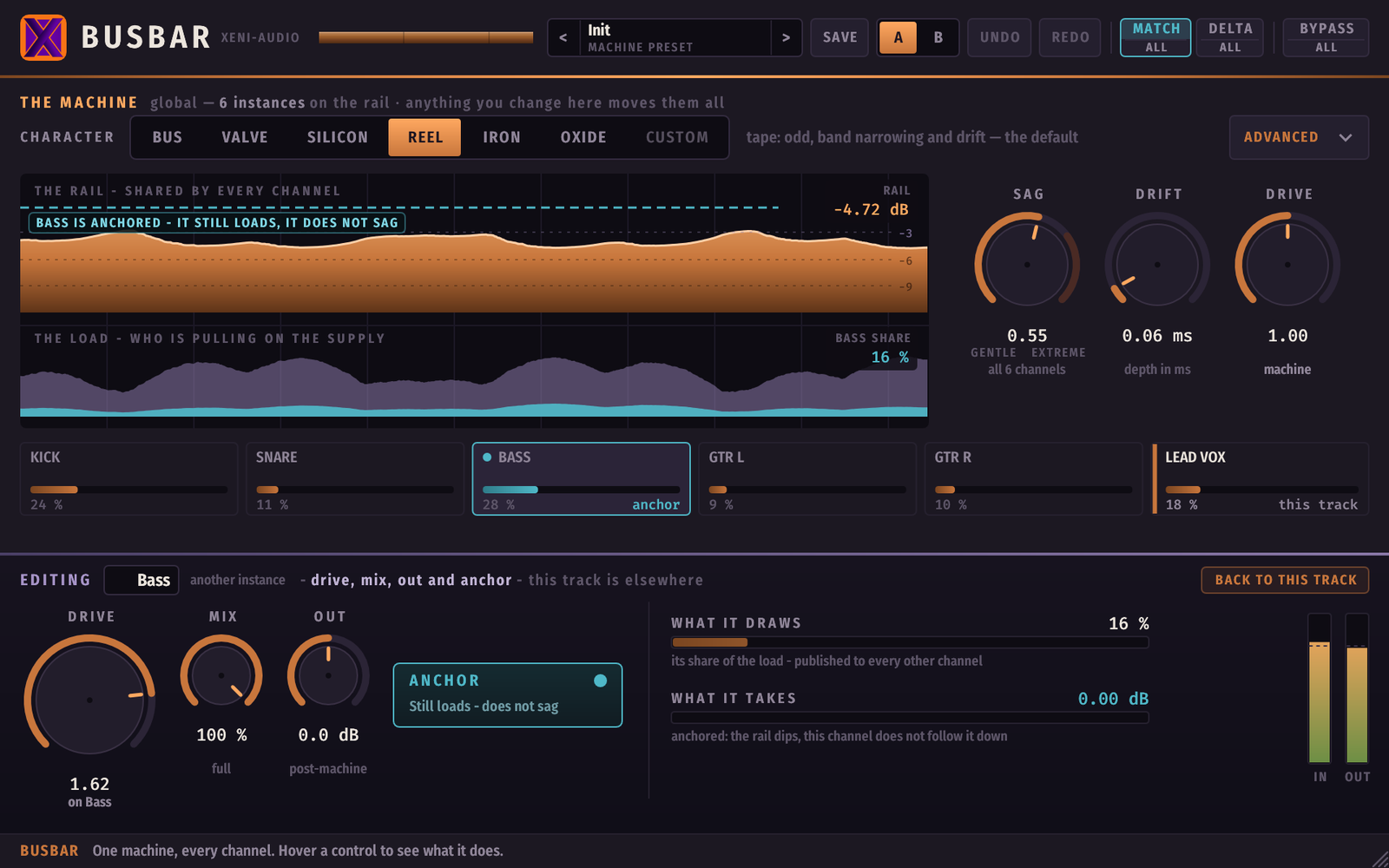
Editing the bass from the vocal's window: its drive, its anchor, its share of the load — the rail callout says why.
Love this thing!
Busbar isn't an emulation, and we'll say it plainly. A shared sag exists on no hardware — it's a deliberate effect, and that's the point: it does something a rack of separate boxes can't.
| Formats | VST3 · Audio Unit (macOS) · CLAP |
| Platforms | Windows 10/11 x64 · Linux x86-64 · macOS 10.13+ (universal, Intel & Apple Silicon) |
| Channels | Stereo in / stereo out |
| Machine size | Up to 64 instances on one shared machine |
| Inter-instance link | Lock-free shared memory — no sidechain bus, no routing, works across plugin formats |
| Characters | 6 measured voices + custom, level-matched |
| Oversampling | ×1 / ×4 / ×8, machine-wide |
| Presets | Machine presets (shared library, live across instances), A/B of the whole desk, global undo |
| Parameters | Automatable in VST3, AU and CLAP hosts |
| Framework | Built with iPlug2 — open-source C++ audio plugin framework |
| License | Perpetual, all your machines, free updates. Separate key from the other XeniAudio plugins. |
The demo is the full plugin — every control, every character, your settings saved with the session. The only limit is that the audio mutes for a few seconds every minute, on every instance at the same moment — because they share one machine. Put it on several tracks of a real session: that is the whole point. No sign-up required.
The Windows installer isn't code-signed, so SmartScreen may flag an unknown publisher. It's not a detection — keep the file and open it.
C:\Program Files\Common Files\VST3\
and
C:\Program Files\Common Files\CLAP\
Nothing to do. The disk image, the installer and all three plugin bundles are signed with an Apple Developer ID and notarized by Apple, with the ticket stapled into the files so it works offline. The publisher shows as Tony Cuny — the legal name behind Xeni-Audio, which is what Apple puts on the certificate. Logic loads the AU with no workaround.
One license, all formats, all platforms, all your machines, forever.